1. Calendar and size range
The first brief should include the current fair and the likely next events. Stand size, open sides, product display needs, meeting capacity, storage options and brand update plans are mapped together.
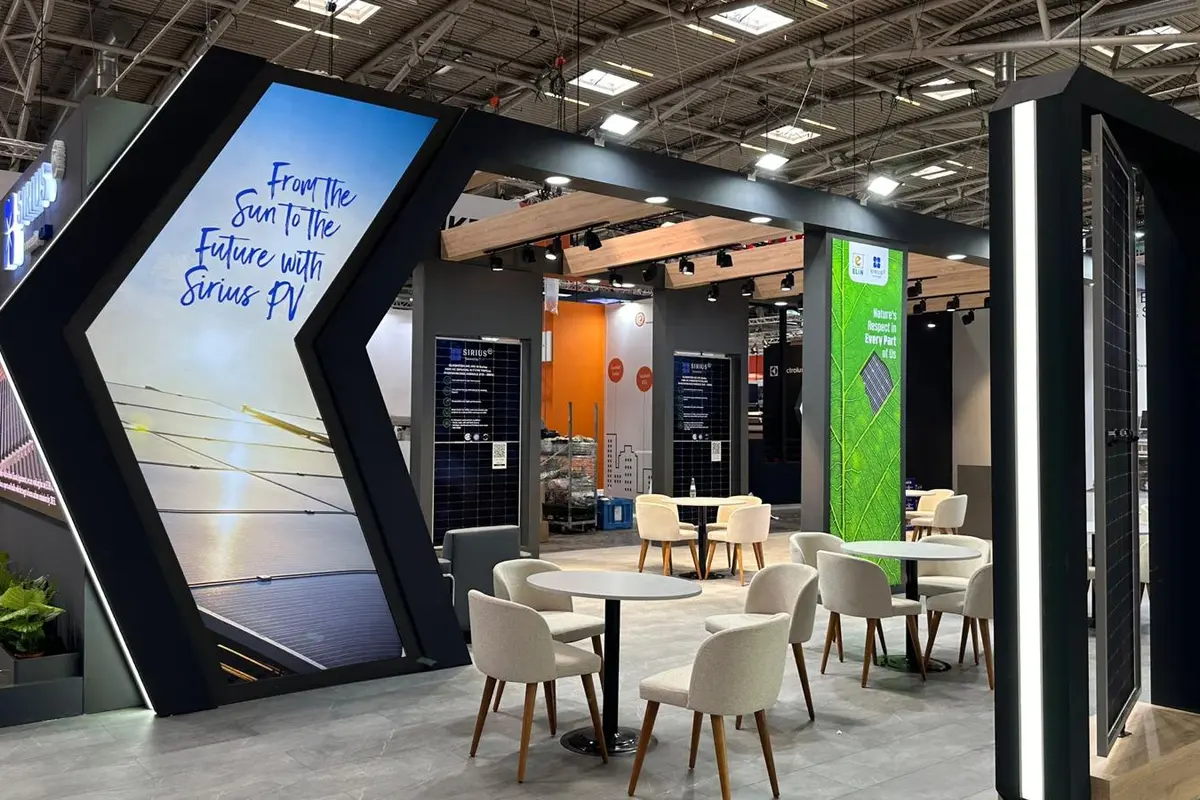
Reusable exhibition stands start with a lifecycle plan: durable structure, replaceable brand surfaces, controlled dismantling, storage, maintenance and reconfiguration for the second and third fair.
A sustainable exhibition stand can still be custom, premium and highly specific to the brand. The important difference is that the technical system is planned for more than one event. The main frame, counters, shelves, meeting room modules, lighting positions and selected product displays are separated from the campaign layer so they can be dismantled, protected, stored and adapted later.
This is different from a one-off custom booth that looks strong for three days but produces a large amount of post-fair waste. In a reusable stand system, the first build is designed with future events in mind: how the elements will be divided for transport, which surfaces will change, which components will need inspection, and how the structure can fit a different stand size or open-side condition.
VAV Group approaches sustainable exhibition stands through production reality, not generic green language. The practical questions are simple: which parts can be reused, which parts are consumable, how will they be stored, who checks damage, and how can the next fair be delivered without rebuilding everything from zero?
The strongest reusable exhibition stand projects begin before the first design render. A brand that exhibits every year in Europe, the Middle East or Turkey can save time and reduce waste only if the first stand is planned around the later calendar. For VAV Group, the lifecycle is a sequence of practical decisions rather than a slogan.
The first brief should include the current fair and the likely next events. Stand size, open sides, product display needs, meeting capacity, storage options and brand update plans are mapped together.
The visual layer stays brand-specific, while the structural layer is simplified into repeatable parts. This helps the same system move from an island stand to a corner or inline stand when the next floorplan changes.
During production, reusable parts are separated from consumables. Components can be marked, photographed and packed so the dismantling team knows what must be protected for future use.
After the fair, the team checks damage, removes or separates campaign graphics, packs reusable parts and prepares an inventory. This prevents the second event from becoming guesswork.
For the second or third fair, the system is redrawn around the new hall rules, booth dimensions, open sides and product priorities. New graphics and selected finishes refresh the brand without discarding the full structure.
After each event, the lifecycle plan should be reviewed. Some parts may continue, some may need repair, and some brand surfaces may be better replaced for a cleaner presentation.
A modular reusable exhibition stand does not rely on a single material. The right system depends on booth size, target finish, transport distance, budget, venue restrictions and the visual standard of the brand. Aluminium systems are strong for repeatable frames, quick assembly and reconfiguration. Timber or mixed-material structures help when the brand needs a warmer custom appearance, stronger product shelves or showroom-like walls. Many projects use both: a controlled modular backbone with custom visible surfaces.
The key is not whether the stand is labelled modular or custom. The key is whether each element has a planned future. A wall that will be rebuilt every time is not a reusable asset. A counter that can be protected, stored and used again is. A display plinth with a fixed campaign print may be consumable, while the internal structure can remain in the inventory.
VAV Group's production background in exhibition stands, project furniture, retail interiors and fixed furniture helps this decision-making. The team can separate what should be durable from what should be easy to refresh. That separation is what makes sustainable exhibition stand design practical for marketing teams.
Search demand for reusable exhibition graphics is a useful signal because many exhibitors do not want to repeat the exact same message at every fair. A stand may need one graphic story for a product launch, another for a distributor meeting, and another for a regional trade fair. That does not require a full rebuild if the graphic layer is planned correctly.
Graphic panels, textile prints, lightbox faces, vinyl surfaces and product backdrops can be specified as replaceable layers. The production detail matters: fixing method, edge finishing, panel size, storage protection and whether the surface can be removed without damaging the core structure. Reusable graphics are not always the cheapest first choice, but they can reduce waste and shorten preparation for the next event.
The honest boundary is also important. Not every print should be reused. Some surfaces are tied to a campaign, damaged during transport or intentionally one-time. A responsible sustainable stand plan names which graphics are reusable, which are replaceable, and which should be treated as consumables.
Reuse fails when storage is treated as an afterthought. A dismantled booth is not automatically reusable; it becomes reusable when it is packed, documented, stored and checked in a controlled way. The maintenance and storage programme should be agreed before the first installation, because dismantling decisions affect whether the next fair is easy or expensive.
Storage can be managed in different ways depending on the project: by the exhibitor, by a logistics partner or through a project-specific arrangement. The critical point is that the inventory, responsibility and condition checks must be clear.
Exhibition stand warranties are often misunderstood. A booth is exposed to transport, venue handling, installation pressure, visitor traffic, dismantling and storage conditions. A responsible lifecycle guarantee cannot promise that every surface will remain perfect forever. It should define what is covered, what is a consumable, what depends on correct storage and what requires inspection before reuse.
For reusable systems, the practical framework is to define component groups. Structural frames, counters, shelves, lighting positions and selected modular panels may be candidates for reuse. Printed graphics, high-contact finishes, rented equipment or event-specific decorative layers may be treated separately. The quotation should make that boundary visible so procurement teams can compare the first-event cost with the total cost over two or three events.
VAV Group can frame the lifecycle promise around the agreed project scope: production quality, intended use, dismantling method, storage condition and future adaptation requirements. This is more reliable than a vague sustainability or warranty claim.
A sustainable exhibition stand claim should be specific and defensible. VAV Group does not claim ISO 14001 certification without project-specific proof. The correct framing is that our reusable stand approach is aligned with ISO 14001 principles: control of materials, waste reduction, planned responsibilities, documented process decisions and improvement over repeated projects.
This matters for European exhibitors because sustainability language is increasingly checked by procurement, marketing and compliance teams. Broad claims such as green stand or eco booth are weak unless the proposal explains how waste is reduced. Stronger language identifies the reusable structure, the replaceable graphics, the storage plan, the maintenance process and the expected second-use scenario.
VAV Group manufactures in Turkey and can coordinate delivery for European venues through a production-led plan. Turkey-based production can support cost control and quality control while keeping logistics practical for Europe, the Gulf and nearby international markets. Typical production for custom stands is 3-6 weeks after design and technical approval, while larger or more complex structures need more lead time. Europe delivery must also consider customs, freight distance, venue access rules and installation windows.
For a defence-industry exhibitor, a modular stand system can be planned around a repeated event calendar instead of a single build. The first fair may use a larger open layout with product demonstration, a reception counter, secure meeting area and graphic wall. After dismantling, the core frame, counters, sample display modules and selected lighting elements are inventoried and stored.
At the second event, the same system can be reconfigured for a smaller footprint. The meeting area is reduced, the product wall moves to the aisle side, and the graphic layer is updated for a different market message. For a third event, the structure can shift again around a different open-side condition. Not every part is reused. Some graphics are replaced, certain finishes are refreshed, and damaged pieces are repaired or remade. The value is that the brand does not restart from an empty production brief each time.
This kind of reuse is strongest when the first design accepts future constraints. It is weaker when a stand is designed as a one-time sculpture with no dismantling logic. The measurable benefit is not a universal percentage claim; it is a more controlled budget conversation over three events, fewer discarded structural elements, and a faster technical planning cycle for the next fair.
| Decision area | One-off custom build | Reusable stand system |
|---|---|---|
| Best fit | Single major event, unique concept, no future calendar. | Repeated fairs, similar size ranges, recurring brand platform. |
| First project cost | Can be lower if no future use is required. | Can be higher because structure, packaging and storage are planned. |
| Cost over three events | Often repeats design, production and waste costs. | Can improve when the core is reused and graphics are refreshed. |
| Brand flexibility | Maximum freedom for one specific event. | Strong when the brand layer is separated from the reusable core. |
| Waste profile | Higher risk of single-use structural waste. | Lower waste potential if dismantling, storage and repair are managed. |
| Procurement question | What is the cost for this event? | What is the lifecycle cost across the next two or three events? |
A sustainable stand is strongest when the design, manufacturing, logistics, storage and next-fair plan are connected. Share your current fair, next likely events, stand size range, product display needs and brand update plans so VAV Group can review whether a reusable or hybrid system is realistic.
A reusable exhibition stand is planned so that core structures, counters, display modules, lighting positions and selected graphic surfaces can be dismantled, protected, stored and adapted for future trade fairs instead of being discarded after one event.
The core frame is checked after dismantling, stored by component, then reconfigured around the next fair's stand size, open sides, product display needs and updated brand graphics.
Yes. Graphic panels, fabric prints, lightbox faces, vinyl surfaces and some product backdrops can be designed as replaceable layers so the brand message changes while the main structure remains in use.
VAV Group can plan post-fair dismantling, component inventory, damage checks, repair recommendations, protective packaging and storage coordination according to the project scope and future fair calendar.
Warranty and lifecycle commitments depend on materials, use conditions, storage, transport and the agreed project scope. The practical promise is defined in the quotation, with reusable components separated from consumable graphics or one-time finishes.
Yes. VAV Group can manufacture in Turkey and coordinate logistics and installation for European venues, with lead time planned around venue rules, customs, transport distance and installation windows.
We do not claim ISO 14001 certification without project-specific proof. Our sustainable stand approach is framed as alignment with ISO 14001 principles: material control, waste reduction, responsible process planning and measurable reuse decisions.
Reuse usually becomes stronger when the brand attends several events with similar size ranges, can store components safely, and updates graphics or layout instead of rebuilding the whole stand each time.
Share your annual exhibition calendar and stand size range for a reusable booth review.